FROM THE FLY BOX
Wild vs. Stocked Trout in Western North Carolina
How to recognize a wild trout, why our streams are stocked, and why the little native brook trout at the top of the mountain may be the most special fish you catch.
Native ≠ Wild ≠ Stocked
NATIVE
A species that occurred naturally here before humans introduced other trout. In the Southern Appalachians, that means the native Appalachian brook trout.
WILD
A trout born and reproduced naturally in the stream. A wild trout does not necessarily mean a native trout: naturally reproducing rainbows and browns are wild here, even though both were introduced.
STOCKED
A trout raised in a hatchery and released into public water to provide recreational fishing opportunities. North Carolina stocks brook, rainbow, and brown trout in designated mountain waters.
A wild rainbow is wild—but not native.
A native Appalachian brook trout can be both wild AND native.
The Native Appalachian Brook Trout
The brook trout is technically a char rather than a true trout, and it is the only trout-like salmonid native to the Southern Appalachian mountains. Brook trout occupied these cold Appalachian streams long before European settlement. Logging, habitat destruction, warming and altered streams, and introduced trout reduced their historic range. Today, many native populations survive in cold, high-elevation headwaters, often above waterfalls or other barriers that limited introduced species from moving farther upstream.
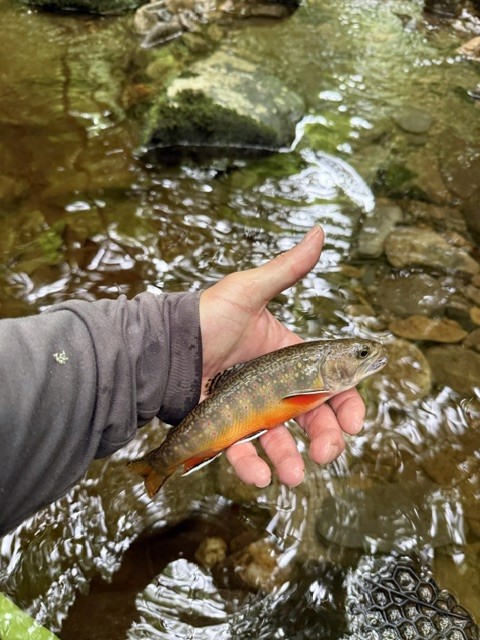
“A six-inch Southern Appalachian brook trout may be one of the smallest trout you catch in Western North Carolina—and one of the most important.”
Catching one is not primarily about size. You’re catching a descendant of the fish that occupied these mountains before rainbow and brown trout ever arrived.
How Did Rainbows and Browns Get Here?
Widespread logging and development changed Southern Appalachian streams in the late 1800s and early 1900s. Rainbow trout, native to western North America, and brown trout, originally native to Europe and parts of western Asia, were introduced to expand recreational fishing opportunities. Over time, both established naturally reproducing populations in many Western North Carolina streams. The species may have been introduced, but an individual rainbow or brown trout born naturally in a WNC stream is still a wild trout.
Why Do We Still Stock Trout?
Modern stocking serves an important purpose. North Carolina manages an enormous recreational trout fishery across the mountains, and stocking creates accessible, predictable opportunities for families, new anglers, Delayed Harvest fisheries, and heavily used waters that could not naturally produce enough trout for the fishing pressure they receive. There is room for both: a day catching stocked rainbows on a Delayed Harvest stream and a day hiking into the Smokies for wild trout are simply different kinds of fishing.
STOCKED TROUT
Often easier to access
Frequently larger
Excellent for families and newer anglers
Important to Delayed Harvest
Creates reliable opportunities
WILD TROUT
Born naturally in the stream
Self-sustaining populations
Often colder or more remote water
Usually more challenging to approach
A different mountain fishing experience
Can You Tell If a Trout Is Wild?
Sometimes. But not always. No single characteristic can definitively prove whether an individual trout is wild.
FINS
Wild trout often have clean, intact fins. Hatchery trout can show rounded or worn fins from close quarters, but healthy stocked fish can recover. A clue—not proof.
COLOR
Wild trout often show vivid color influenced by diet, environment, camouflage, genetics, and spawning condition. Color alone cannot determine origin.
BODY SHAPE
Wild trout often look lean and athletic. Recently stocked fish can have a uniform hatchery-fed shape. Again, this is only a clue.
LOCATION
This may be the best clue. Several miles into a GSMNP drainage where trout reproduce naturally and no stocking occurs, there is much less mystery.
Look for the “Paw Prints”
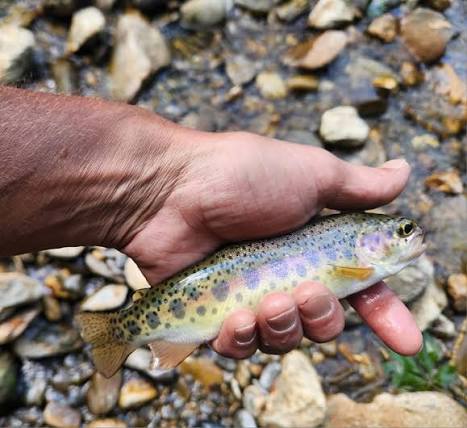
Young and smaller wild rainbow trout often retain dark vertical or oval markings along their sides called parr marks. On Western North Carolina mountain rainbows, they can look like little paw-shaped smudges running down the fish. Local anglers may call them “paw prints.” They’re a useful visual clue—but stocked juvenile trout can also display parr marks, so no single marking can prove where a fish was born.
SEE THOSE DARK SMUDGES?
They’re called parr marks.
Want Wild Trout? Start With the Smokies.
Great Smoky Mountains National Park is one of the best places near Purple Top to intentionally pursue naturally reproducing trout. Use the existing local water guides below to choose your kind of day.
ROAD PRONG
High-elevation native brook trout water.
NOLANDS CREEK
Wild mountain trout and beautiful Smokies water.
DEEP CREEK
A classic Smokies watershed with increasingly remote water.
HAZEL CREEK
Remote wild trout water and lake-connected browns.
OCONALUFTEE
Wild trout opportunities in a larger river system.
ROUGH BUTT CREEK
Small, high-elevation wild trout water.
Follow the Water Up
As you gain elevation, the fishery can change: lower and mid-elevation systems may hold wild rainbows and browns; higher, colder water increasingly favors cold-water species; and headwaters can hold native Appalachian brook trout. Waterfalls and other barriers have sometimes protected those populations. The exact transition varies by drainage, so elevation alone is never a guarantee.
Why Wild Trout Matter
Wild trout are indicators of functioning cold-water ecosystems, but wild trout fishing also changes what a good fish means. A 15-inch stocked rainbow may be considerably larger than a six-inch native brook trout. Size isn’t always the point.
Sometimes the smallest fish is the one worth hiking the farthest to catch.
Find Your Water
From stocked Delayed Harvest rivers to tiny native brook trout streams, Western North Carolina offers remarkably different trout experiences within a relatively small area.