FROM THE FLY BOX
Native Brook Trout in Western North Carolina
The Southern Appalachian native—and one of the best reasons to slow down, look uphill and fish the coldest water you can find.

A small fish with a big sense of place.
The brook trout is the only trout native to the Southern Appalachian waters around Western North Carolina (though technically they are a member of the char family). They are not usually the biggest fish you’ll catch here, but they live in the cold, shaded headwaters that make these mountains special. For me, that makes the experience as important as the fish.
NATIVE VS. STOCKED BROOK TROUT
Not every brook trout you catch in Western North Carolina represents the same kind of fishery. Southern Appalachian brook trout occur as wild native populations in cold mountain headwaters. North Carolina also raises and stocks brook trout in managed trout waters, including Delayed Harvest sections. They may both be brook trout, but the experience—and the significance of the fish—is very different.

SOUTHERN APPALACHIAN NATIVE
Born here. Wild here.
These are the fish we’re talking about when we go high into Southern Appalachian headwaters. They are naturally reproducing wild fish from populations native to these mountains, typically living in small, cold, high-gradient streams above natural barriers.
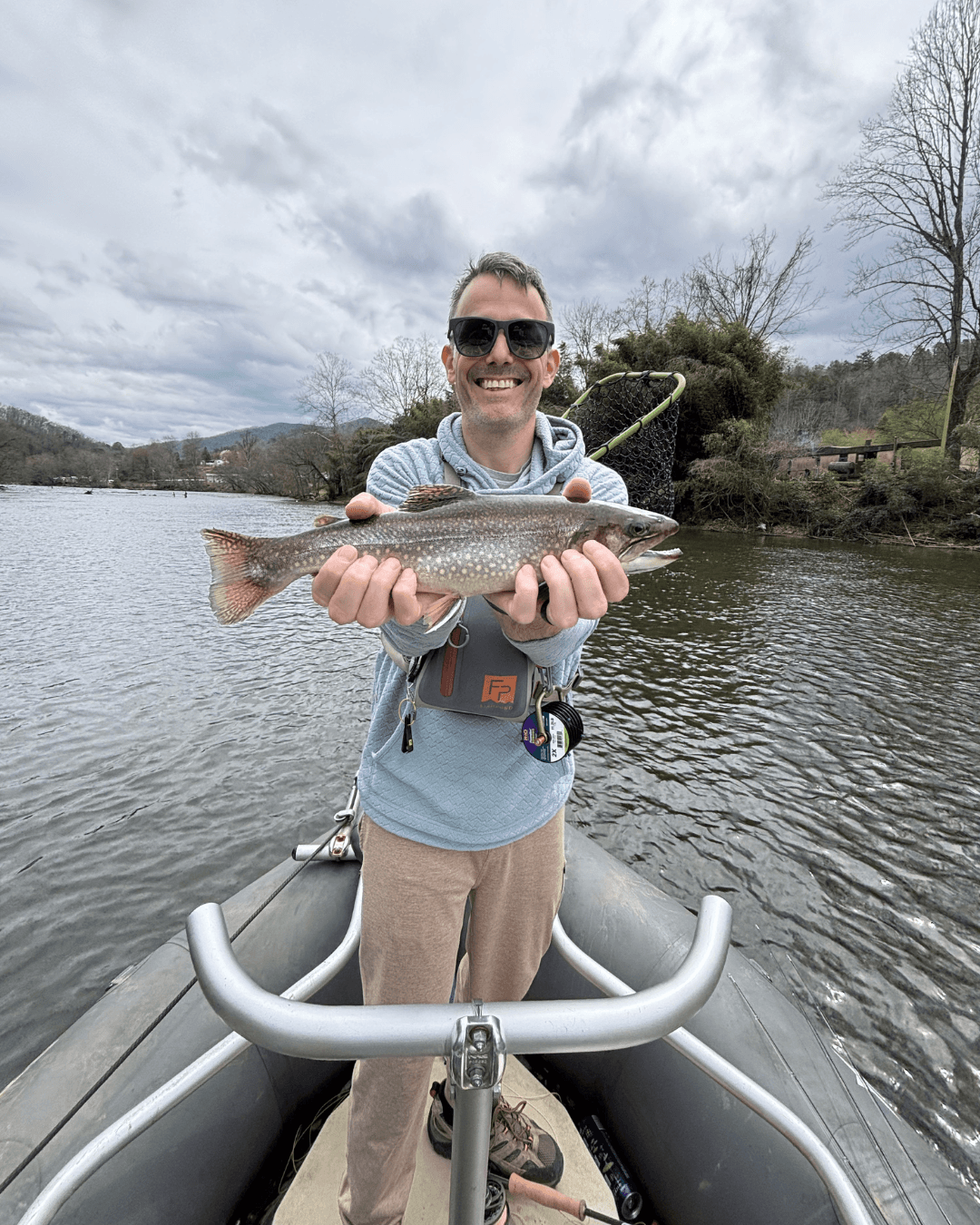
Olive or dark back · worm-like vermiculations · yellow spots · red spots with blue halos · orange or red lower fins with black and white edges.
Typical: 4–8 inches. Very good: 8–10 inches. Trophy territory: around 10+ inches in genuinely small native headwater water.
“A 10-inch native brook trout from a creek you could nearly jump across is a big fish.”
HATCHERY-STOCKED BROOK TROUT
Same species. Different fishery.
North Carolina also raises brook trout in hatcheries and stocks them into managed trout waters, including Delayed Harvest sections. These fish are intentionally stocked to create recreational fishing opportunities and can be considerably larger than the native brook trout found in mountain headwaters.
A stocked brook trout may be 12, 14 or more inches while a native brook trout from a tiny mountain creek may only be six or eight inches. That doesn’t make the stocked fish bad or less fun—it represents a different fishing experience.
“A 14-inch stocked brook trout is a nice fish. A 10-inch native from a tiny headwater can be a trophy.”
Size and appearance alone cannot prove whether an individual fish is genetically native or hatchery-derived. Location, population history and genetics matter. So how do you find the native fish? Start by looking upstream.
Look uphill for the coldest water.
Native brook trout thrive in cold, clean, shaded headwaters and high-elevation tributaries. In the Smokies, that often means small streams, steep approaches, and water where elevation does more work than stocking ever could. Road Prong, Walker Camp Prong and other high-country tributaries are the kind of places we start looking when lower water warms. If you work your way upstream from the bridge on Robinson Creek you can find these beauties, but you are going to have to work for it.

LOOK FOR THE BARRIER
As I work upstream toward the headwaters, one of the things I’m looking for is a natural barrier—usually a waterfall or steep cascade—that other trout can’t get past. Below that barrier, you may find rainbow, brown and brook trout living in the same watershed. Above it, you can sometimes find an isolated native brook trout population.
Natural barriers matter because they can prevent introduced trout from continuing upstream and help protect native brook trout populations in the headwaters. A barrier is an indicator, not a guarantee that native brook trout are present.
“When the creek gets smaller, colder and steeper—and you cross a waterfall that looks impassable to a trout—pay attention. You may be entering brook-trout country.”
Small water rewards a lighter touch.
Short casts. Small flies. Think tight streams and bow and arrow casts. Careful approaches. On tight headwater streams, a 3wt or 4wt is usually plenty, and the goal is often to place one accurate cast without lining every pocket. Move slowly, keep a low profile, and treat the stream as a connected habitat rather than a series of isolated holes. A seven-inch native fish from a tiny high-elevation stream can be one of the most memorable fish of the year.
The smaller the water, the more deliberate the fishing. I've caught brook trout in what appeared to be no more than a puddle.
THE SMOKIES DIDN’T JUST PROTECT THEM. THEY BROUGHT THEM BACK.
Great Smoky Mountains National Park has actively worked to restore native Southern Appalachian brook trout to portions of their historic range. Logging and habitat degradation changed cold-water habitat, while introduced rainbow trout competed with native brook trout and pushed them into smaller upper reaches.
Where suitable historic habitat is protected by a natural barrier, often a waterfall or cascade, Park fisheries crews can remove introduced trout from above the barrier and re-establish native brook trout. That is the larger conservation story behind the clue we look for while working upstream.
LYNN CAMP PRONG
Lynn Camp Prong is one of the clearest examples of native brook trout restoration in the Smokies. The project was developed in 2007, treatment began in 2008 above a natural cascade barrier, and the final treatment occurred in 2011. NPS reports that the population is flourishing after rainbow trout were removed and native Southern Appalachian brook trout were reintroduced.
RESTORATION AT SCALE
The current NPS Lynn Camp Prong information reports 11 restored native brook trout populations totaling 27.6 miles of stream. Park fisheries crews continue monitoring these populations with scientific sampling, including electrofishing surveys that allow trout to be captured, measured and returned to the stream.
So when you climb above a waterfall in the Smokies and catch a native brook trout, there’s a chance you’re fishing water that people deliberately worked for decades to protect or restore.
Why they matter
Native brook trout are part of the ecological story of these mountains. Keep them there by following current regulations, using the permitted tackle for the water you’re fishing, cleaning gear between watersheds, and handling fish with care. In the Smokies, don’t move rocks or build stream dams; protect the habitat that makes these fish possible.
Keep exploring
Start with Road Prong, read the Wild vs. Stocked Trout guide, and review Wading Safety before heading into unfamiliar water.
Find the cold water.
Explore the streams, seasons and safety notes that shape a day of native trout fishing around Purple Top.
EXPLORE WNC TROUT WATERS →